
Welcome to the The Greenlands! I am a filmmaker with four ‘No Budget’ feature films under my belt, so far … some have even, amazingly enough, been selected for screening at international festivals. I have set up the-greenlands.com to be a transmedia proving ground, hoping to raise interest and pennies for my planned, 4-season web series (and features’ tours): The Greenlands Chronicles, and my ‘The Greenlands Musicals’ (already both written) which are feature comedic musicals, “Memo re. Elves: Uncovered” and “Memo re. Elves: REcovered
The Banshee
Do Banshees Scream, or Weep?

Description
The banshee is a female spirit connected to Irish burial tumuli. Her most common appearance is said to be that of wearing a green dress with an old grey cloak. A banshee is usually seen as an old woman with a haggard grey face. Some sightings insist, however, that their banshee is red-haired, with a white dress and an white face. A banshee’s eyes are always red, from weeping and they are seen as small folk, between one to four feet. Scottish Celts see their banshees as having drooping breasts, one nostril and webbed feet.
Behaviour
Banshees are said to belong to specific families. They are heralds of death and are also known as the ‘wailing women’, or “keeners”. Keening is what women did at Celtic funerals when ‘crying the coronach’. Keening ranges from moaning, through wailing to screeching and, at Celtic funerals, was often accompanied by women tearing their hair and rending their own clothes. Celts had professional keeners who went around from funeral to funeral. Banshees are usually seen crouching beneath trees, but they can often fly past you, while wailing, and then you know that someone in the family is going to die. Several banshees wailing together betoken the death of a great hero, or someone holy. Their screeching can shatter glass. Scots Celts sometimes see a banshee washing the clothes, or armour of a person who is about to die, and they call her the ‘little washerwoman’: bean nighe. Nowhere is there a record of banshees being mischievous, or causing death. They merely foretell it.
Origins
The Old Irish word for banshee is ‘ben side’ which is pronounced banshee. This means ‘woman of the fairy mound.’ The Norse also had banshees, as did Middle Earthlings.

Point of Interest
Most surnames associated with having banshees are Goidelic Celts, i.e. their prefixes are O’ or Mc/Mac.
Witness Account
An account has been collected of a great family of fishers in a village by the sea in Cornwall, near Tintagel. This family were the eighth generation of fishers and there were three sons each with three big boats. The eldest son, Trefussis, decided upon the fishing grounds and he left the fish preparation and selling to his wife, as was always done. Treffusis was blessed with four children, but the boy child was the love of his life. Iachan was seven years old and ruled his mother and sisters with an iron rod, as, he told them, one day, he, too, would have a boat of his own.
One day, Elisa, the eldest daughter of Trefussis , who came to look for the boy, for to get his dinner, found him, half way up a cliff, looking for birds’ eggs to steal. She called him down, but he refused to listen to her, telling her to return home, as he wished to raid all of the nests on that cliff. When eventually he returned home and his mother attempted to remonstrate with him about the dangers of sea cliffs, he told her to ‘Go to’ as he was doing man’s work.
Trefussis, himself was forced to reprimand Iachan, one day, when he found the boy deliberately wading out into the quicksands in order to find crabs to kill. Iachan explained to his father that he didn’t need any exhortations because he was the next head of the family and would be in charge when his father had gone.
One day, Iachan’s mother was filleting the herring down on a trestle table on the beach, with the other fishwives. They were putting the prepared fish into barrels of salt with layers of salt in between. It was very messy work, gutting fish, but Iachan’s mother had kilted up her skirts over her Trefussis’ old trousers. Suddenly, interrupting the banter of the fishwives, was heard a terrible, eldritch scream, followed by a high, wavering wailing. Iachan’s mother looked along the beach in the direction of the children, at the far end. She saw a lot of movement and two children detach themselves from the group and come running down the beach.
Iachan’s mother ran towards them and they dragged her to the deep rock pool at the edge of the cliffs where the children were forbidden to fish. This pool was deep and had terrible undercurrents. Iachan’s mother saw Iachan’s little cap floating on the clear waters of the pool, and the children shouted that Iachan had fallen whilst fishing there. They could not stop him, they said. Luckily, Iachan’s mother’s friends had run up to and were able to take the arms of the mother and prevent her casting herself into the pool to look for the boy, whilst her wails joined the terrible wails that went on from a small old woman in a green dress on the top of the cliff.
This tale demonstrates how banshees can herald death from the inside of a house, but even in the outer elements, too.

The Baobhan Sith
Etymology
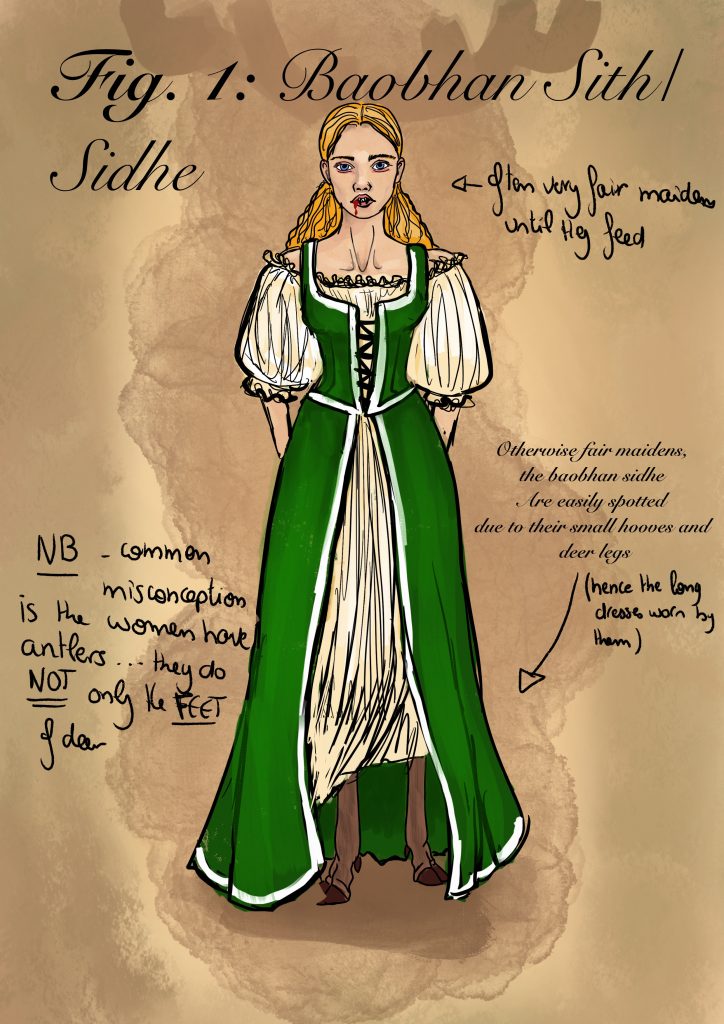
Baobhan Sith is Scottish Gaelic and actually means “Fairy Woman”. The word does not have an agreed upon spelling, only an agreed on pronunciation, so has been spelled both Baboan Sith, Baboan Si and Baboan Sidhe. (Pronounced Bavon Shee).
Different Types
The Baobhan Sith are a form of beautiful woman that is secretly a vampire monster, of which there are millions of varieties all across the many cultures. This specific variety is from Scotland. They are associated with the ‘unseelie court’ due to their tendency towards eating humans.
Behaviour
The Baobhan Sidhe are a race of very beautiful looking monsters, who take the form of beautiful young women often wearing green dresses. Their long green dresses hide the fact that their legs and feet are that of deer. They prey on men using their feminine appearance to disarm them and get close; only to then slit open their throats and chests and drink the men’s blood dry. The Baobhan Sidhe have various was of acquiring lone men. Usually, they prey on groups of hunters. They have a particularly powerful attracting magic that makes men follow them: rather like sirens, to their doom. The Baobhan Sidhe can also come when called upon, usually accidentally by a lone man. The man might wish for some female company and suddenly a beautiful woman will just happen to be passing by. This is linked to The Scottish saying that states that wishing at night without invoking god means that the wish will be granted, but in a most horrible manner.

How to protect yourself
Since the Baobhan Sidhe are fairies, of the unseelie court, that means that iron will work as a great deterrent for them. It will not only hurt them, but dull their senses and allow you to escape. The Baobhan Sidhe do not seem to be great fighters in the legends that mention them, so maybe a determined man with a dog and an iron weapon of sorts may survive an attack
Witness Account
There were four men who went hunting and took shelter for the night in a lonely hut. They all decided to warm their bellies with whisky and food and it wasn’t long before they were very merry. One of the men remembered an old song they would sing, and soon the others began dancing .Of course though, one has to admit just three men dancing in a small hut is not very entertaining, and soon the men took to wishing that they had some beautiful young ladies to dance with. The singer laughed at their sighs and declared he would not want his fair wife to be with him in such a dirty hut stinking of whisky. His companions jeered and took to describing their ideal maids as they got drunker. Then suddenly there was a knocking at the door. One of the men opened the door and let in three fair maidens all bundled up against the cold. The maids were very fair and told the men that they were travelling to meet their mother in another town. As they drank and were merry the singer noticed that the maids resembled suspiciously the ideal maids described by his friends. But on he sang and his companions danced and were merry. Suddenly the singer, being the least drunk of all of them, noticed one of the maids had hooves. He excused himself and fled from the hut, taking refuge among the horses and the dogs. The merriment from inside the hut suddenly ceased and silence fell. He heard footsteps and sounds like women’s whispers and saw the three maids now with monstrous appearance make their way around the horses searching for him. He hid further under the horses. Fortunately, the hunting dogs took to barking and baying loud enough to raise the dead, and so the women fled. The man went back inside and found all three of his friends dead and drained of blood.

The Werewolf
Were They Just Weird Wolves?
Etymology

The word ‘werewolf’ comes from the Old English ‘were’ for man and ‘wulf’ for wolf. This, in turn, comes from the Old Norse, ‘varulfur’. Lycanthropy, or the ability to change into a wolf, is a type of therianthropy, which is the general ability to shape shift, to an animal
Different versions
The more modern ideal of the werewolf being a sort of Jekyll/Hyde monster: human most of the time, and monster for one night a month, is a relatively new concept. In old Ireland, werewolves could live normal, if isolated lives, as shapeshifters. They might sometimes help humans, but usually stayed away. They were often revered as much as misunderstood. Other werewolves functioned a little like people with anger issues, and could be turned back into humans by being called their name by a loved one, or a loved one giving them their human clothes. There is, of course, the modern werewolf that is a contagious irredeemable horror that lives to kill on the night of the full moon.
Behaviour
Behaviour depends on the type of werewolf. The more ancient versions of the werewolf simply behave like a rather intelligent wolf. They stay away from humans and simply hunt animals. These werewolves can choose to turn into wolves and often did so for the sake of convenience. However, the other kind are the ones that are cursed to turn into a rather vicious and strong form of wolf, that are prone to attack and hurt as many humans as they can. The cursed ones usually turn into a wolf on the night of the full moon, as the full moon is often associated with madness and witchcraft.

How to protect yourself
Werewolves were often mentioned at witch trials from the C15th to the C18th. These mentions, however, stopped with the end of the witch trials, in the early C18th, in Britain. The older form of werewolves could be as easily injured as you and I. Many legends refer to hunters hurting a wolf and then discovering a neighbour with a limp. The cursed Savage werewolves are a different story. They are considerably harder to kill, with tradition stating that only silver or another werewolf can hurt them. If you ever encounter one of those werewolves , unless you have a six shooter with silver bullets, and a suit of silver armour you are unlikely to have long to worry about your survival.

Witness Account
Our researcher was told an account, by an elderly grocer who knew of a young man who was discovered to be a werewolf. This young man had recently returned to London, from a holiday in Bavaria. The young man, called Oliver, was a cellist with the London Concertante orchestra and he had taken this holiday on his doctor’s recommendation, due to his having weak, consumptive lungs.
Oliver’s fiancé, Lisa, came to meet him at Dover, as his ferry arrived. “You don’t look very rested, my dear” she said. “Oh, I just overdid the mountain walking, a little. That’s all” said Oliver. On the train back to London, Lisa was disconcerted to discover that poor Oliver also had a bound hand, due, he said, to slipping with his fruit knife. That evening, at dinner, Lisa slipped a signet ring that she had had made for Oliver, onto the little finger of his left hand. It had an ‘O’ with an ‘L’ across it. Oliver kissed her for it.
Lisa resumed coming to meet Oliver from his late afternoon rehearsals, as usual, but she noted that he frequently seemed a little uninterested in her and somewhat anxious to be away. Oliver started making excuses for being unable to see Lisa, in the evenings and Lisa, began to be sad, thinking that perhaps Oliver was repenting his choice of her.
One evening, not seeing Oliver at the rehearsal finish, Lisa went along to his rooms, in the Albany. She tapped on the door as she opened it, but was confronted with a horrified Oliver who had blood all around his mouth, feathers on his waistcoat and a dead, torn pigeon on the table in front of him. Lisa, stared in horror, turned and fled, followed by Oliver’s urgent calls.
The following morning, over breakfast, Lisa read an article in The Globe which spoke of a wolf being accidentally killed by a handsome cab, in the Albany. The wolf had been found to be wearing a ring with ‘O’ and ‘L’ across it, on the little finger of its left paw. Lisa dashed across London to Oliver’s rooms. He wasn’t there. Oliver was never found. The Concertante had to find another cellist.
The Pixie
Pixies, or Piskies?

Etymology
Pixies are of Celtic origin. There seems to be no clear origin for the word, no clear lineage to trace it to, it sort of surfaces all over England and Cornwall, where they were revered to as pigsies . The word is a little similar to the Irish Celtic (Goidelic) word, Aos Si, but this is inconclusive. Most accounts of pixies are from the South West of Briton. The odd pronunciation of Piskies also comes from there as the local people had a habit of turning ‘letter couples’ around, the other way from the Standard English
Different types
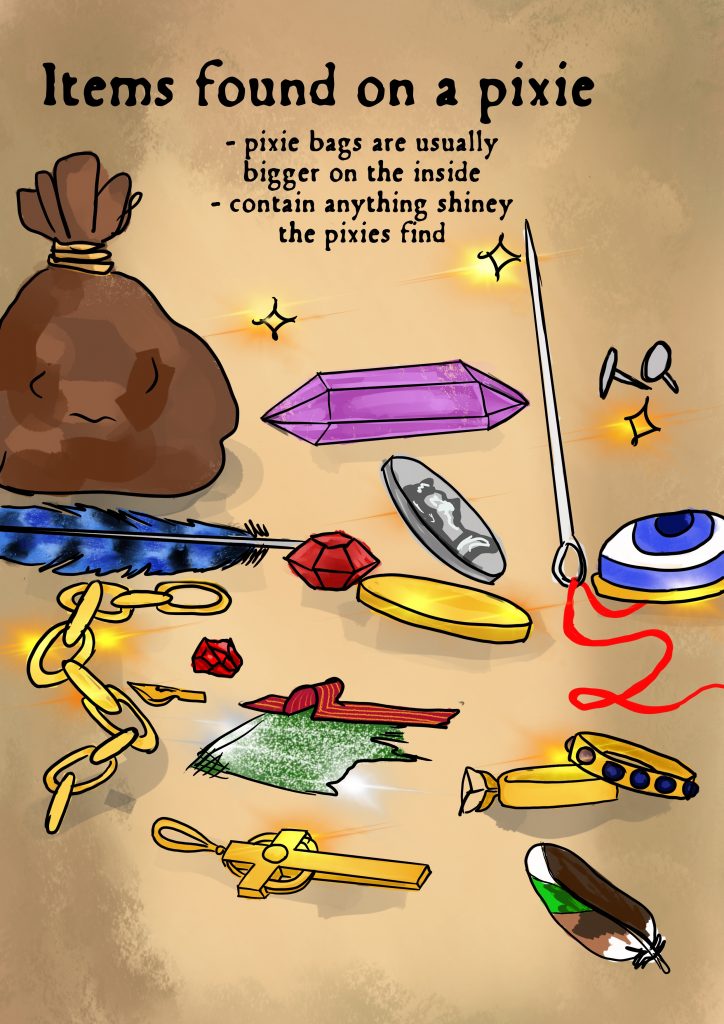
Pixies generally follow the theme of being small people who live in burial mounds and under hills and large stones. They are all known for stealing small shiny things. In most legends they are famed for their dance parties, hence fairy rings but in Cornwall the Pixies are also famed for their wrestling matches. Some pixies are though to have wings rather like those of butterflies or dragon flies, others just walk everywhere prosaically. Some are known to have been covered in blue tattoos of wode, and in the recent century it was declared that pixies had pointed sharp eyes

Behaviour
Pixies, as opposed to elves, are always harmless, or friendly to man. Despite this they do like to be mischievous. Although the scale of their mischief is of the slightest, such as blowing out candles, or stealing thimbles. They live in between our world and the full blown world of the elves. Pixies are fond of music and dancing, thieving and in some cases wrestling. They are blamed for the disappearances of shiny and brightly coloured small things. The items have to be small as the pixies are small themselves. They like to ride on the backs of wild horses. Some people can often hear their laughter In certain place, but, because pixies are so small and fast, they can’t be seen. Pixies are said to be great explorers and have had occasional battles with the elves.
How to protect yourself
Iron. If you don’t want it stolen, nail it down, with iron. Wood, bronze or cloth will not work. They are mildly irritating at best but if you leave food out for them they will not bother you.
Witness Account
This account was received from an old herbalist woman, in the village of Trebirren, Cornwall.
The local butcher was a man named Laen, he was rude and brutish, but did quite a good job of hiding it. He had recently decided that he was the marry the local yoeman’s daughter Elise. Elise was a pretty kind little thing, but not only that had a good dowry, that would set up any man who married her for a good life. Now one of the features Laen apart from his temper was his disregard for anything that could be seen as “nonsense” which is why, when he came into his kitchen one morning to see two small pixies attempting to steal a sugar bowl, he threw his chamber pot over them and hit them with his boots. Now anyone who knows anything about dealing with fair folk knows this was possibly one of the stupidest decisions in his life. The pixies swore revenge and Laen’s life was never the same again.
Laen went a courting Elise, bringing flowers and many little gifts. Elise didn’t particularly like him, but her parents told her that he would be a good husband and that they approved of the match. When Len proposed, Elise said that she would think about it and ask her parents. Her father, when she told him, later, pointed out that he and his wife were old, now, and that they would feel a lot happier if they knew that the butcher was going to be caring for her. Elise therefore accepted Len’s proposal, but asked for a few months, before the wedding. Laen was perfectly happy to wait a few months for such a pretty wife and a large amount of money, everything seemed to be going fine
Len now came courting every weekend. One day he turned up and was confounded when Elise’s mother was staring at him as if he was a mad man, and when he plucked up the courage to ask what was wrong, he was informed by a giggling Elise that as he had his breeches undone in a most ungentlemanly manner. Horrified, he rectified the offending garment, but had to leave the house as Elise’s mother was most offended.
A few days later, after greatly apologising to Elise and her mother and her father Laen came a courting again, this time gave Elise a box containing a necklace of semi-precious stones. He had spent quite a bit of money on this and was very proud. But when Elise opened the box however, there was only a daisy chain there. As elises mother now refused to be in company with Laen, Elise’s father was to be her chaperone, was not impressed by the daisy chains fancy box. Laen at this point was angry, as he knew he had checked the contents of the box before leaving his house! But he had managed to keep his cool in front of his father in law, so all was well.
His misfortunes continued, the following Saturday, when Laen turned up at Elise’s father’s, he removed his hat to find it all wrapped up in bows. Elise and her father collapsed laughing. Now Laen placed a lot of importance in his physical appearance and this jape was too much for him. He forgot himself, tore the bows from his head and roared at Elise and her father for laughing at him. He slammed the door and left. Now Elise’s parents were good folk and were fond of their daughter, the mother had already been impressed of his bad nature, but the father had convinced her she was maybe judging him too harshly. But with Laen’s outburst, Elise’s became worried that maybe his wife had been right.
Finally, a week before the wedding, Laen turned up on horseback, towing another, to take Elise for a ride. Her father begrudgingly went to get his own horse to accompany his daughter on this ride, as he did not have much faith in Laen’s good character. As they left the yard and were trotting out of the gate, Elise’s cat appeared before Laen’s horse and it danced backwards on its hind legs supported by two little angry pixie men. Laen’s horse shied and threw him off, Lean’s temper snapped, he sprang up, grabbed the cat, and whirled it around by its tail, throwing it into the road. Both Elise’s father and mother were witness to this violence and were horrified. They called off the wedding and banned Laen from ever going near their family again. Nobody but the wise woman saw the sharp shining eyes of the two pixie men watching from the hedge as they grinned at Laen’s downfall.
The Incubus
What Exactly Do incubi Do?
Etymology
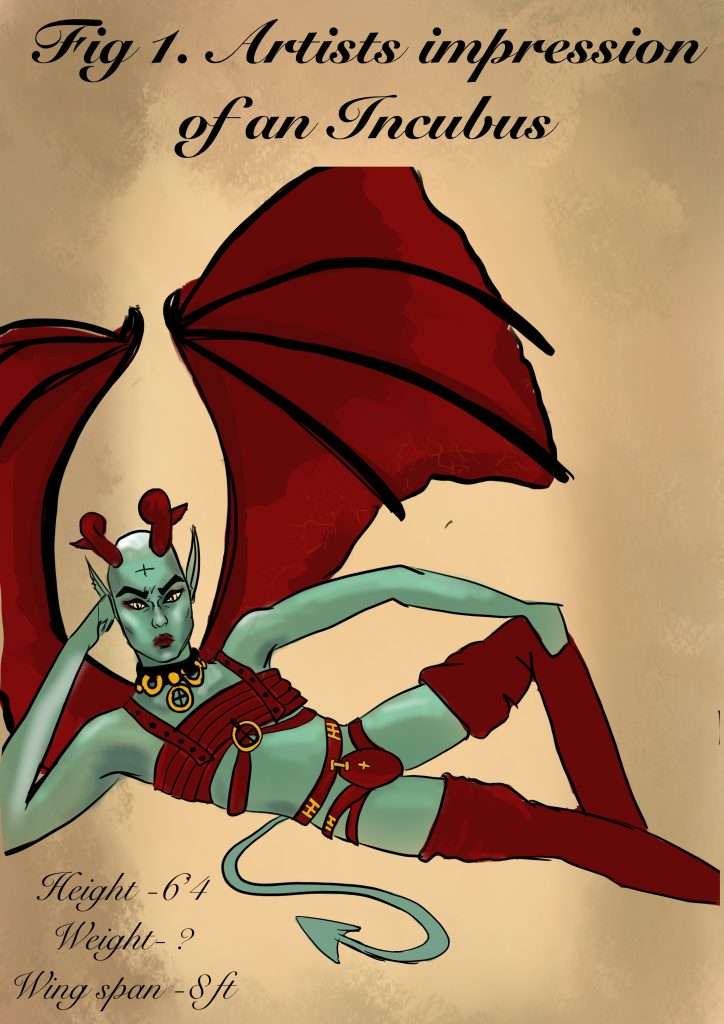
The word incubus comes from the Latin word incubare which means to lie upon. It is the most common name for these demons in the west, although demons who commit the same acts appear in Mesopotamian texts under the name Lilu. In the ancient times, these demons were storm demons, but due to a mistranslation, became seducers of women, which, in my exalted opinion, is a good way to go down in history. Incubi’s origins are quite simple, as their name has remained the same in our language since Roman times.
Different versions
These demons have many different slight variations, from being shape shifters, to racists, to deciders, from monstrous to attractive. It’s all over the place, they are usually associated with sleep and nightmares, and all universally agree that consorting too much with an incubus can result in a decline in health, mental health and even in death.
The Catholic Church has put considerable thought into these demons over the years and declared both the incubus and succubus to be the same demon capable of shape shifting. The church also declared incubi to be responsible for the pregnancy of nuns, and the fathers of many children. The church also gave the incubi the power to revive corpses for sexual escapades and other rather peculiar powers. It is said that the father of the great wizard Merlin was an incubus
Behaviour
Incubi are male demons who prey on women in the night, when the women are in bed. They were often blamed for mysterious pregnancies and other events of the sort. Later societies, maybe feeling like the women shouldn’t have all of the fun, also developed the female attacker of men idea: succubi. These (female) succubi were supposed to suck all the life force from human men, but, unfortunately, it was seen as being considerably less threatening, and a more … alluring and fun way to die. The male incubi are known for preying on women who are either conscious, or unconscious. They do not seem to be picky. Incubi are known to have fathered half demon children called ‘cambions’ that often kill the mother. Some of the slight less horrifying versions of the incubi simply lie on women to smother them and make them wake up with night terrors. The cambion was only used to refer to the child of demons since the 19th century. The incubi are associated with sleep paralysis and various forms of non sexual nightmares.
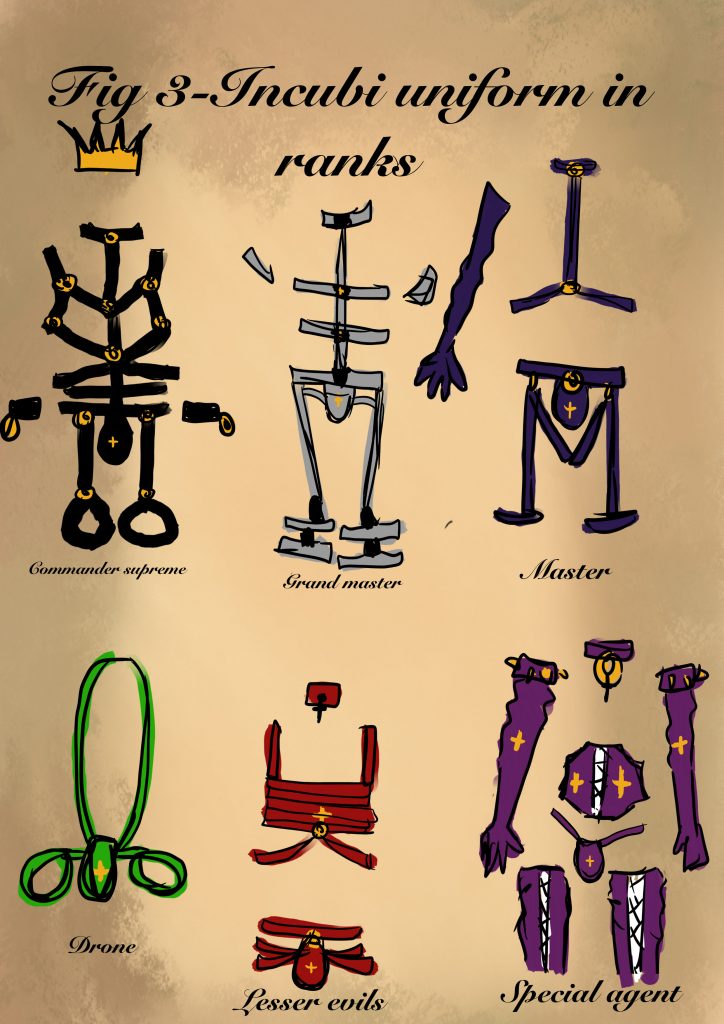
Ways to protect yourself
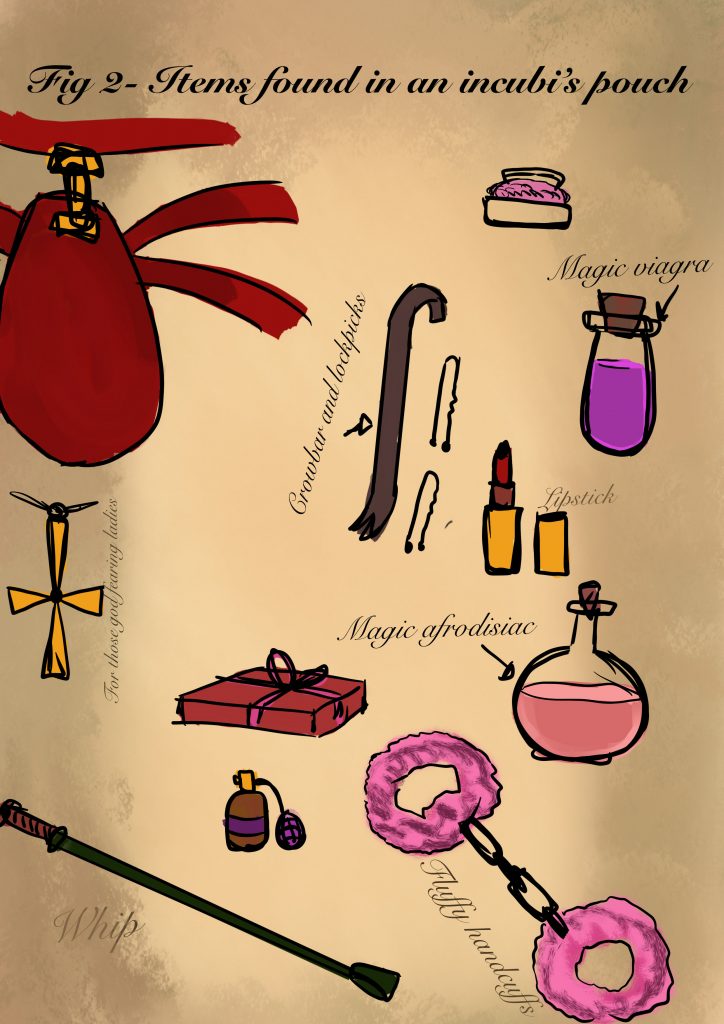
Since the Catholic Church put a great deal of thought into these demons, they also provided the main solution for an attack. As listed in the Malleus Malificarum, these solutions are : an exorcism by a priest, making the sign of the cross, regular confessions, praying a lot, or leaving the location to sleep somewhere else.
Witness Account
This is taken as a second hand recount from a tired and drunken Irish priest from a small pub in south London. He recounted the tale of a young woman in a small town in Ireland that he refused to name. He said that she was kind, innocent and pious . This woman was visited in the night by an ugly creature who sat at the foot of her bed and bemoaned and bewailed its fate and its looks. Being the kind girl she was, she attempted to speak to the creature, to comfort it. It declared it was miserable because no one would ever love it, especially a woman. The woman attempted to reassure it, and they spoke for a long while, until the dawn made it run away. The woman simply put the strange meeting down as a dream and forgot about it. For the next few months the creature visited her, and slowly seduced her. The young woman was convinced that she could redeem the creature by showing it love. Over time the woman’s health began to deteriorate and her family became very concerned. The priest was called, when it was discovered that the young womsn was pregnant and the pregnancy showed anomalous properties. The priest realised it was an incubus causing these ills and attempted to exorcise the creature. He did manage to block the creature from returning to his victim, but the girl was so far gone, both in her pregnancy and her obsession with the creature, that she died giving birth to a stillborn child.
The priest then proceeded to drink a lot of scotch and slide into incoherence, so our collector of tales purchased him a cab and sent him home to his lodgings.
It appears that incubi can be quite crafty creatures who adapt to each situation to get what they want.
The Goblin
Have Goblins Just Had a Bad Press?
Description
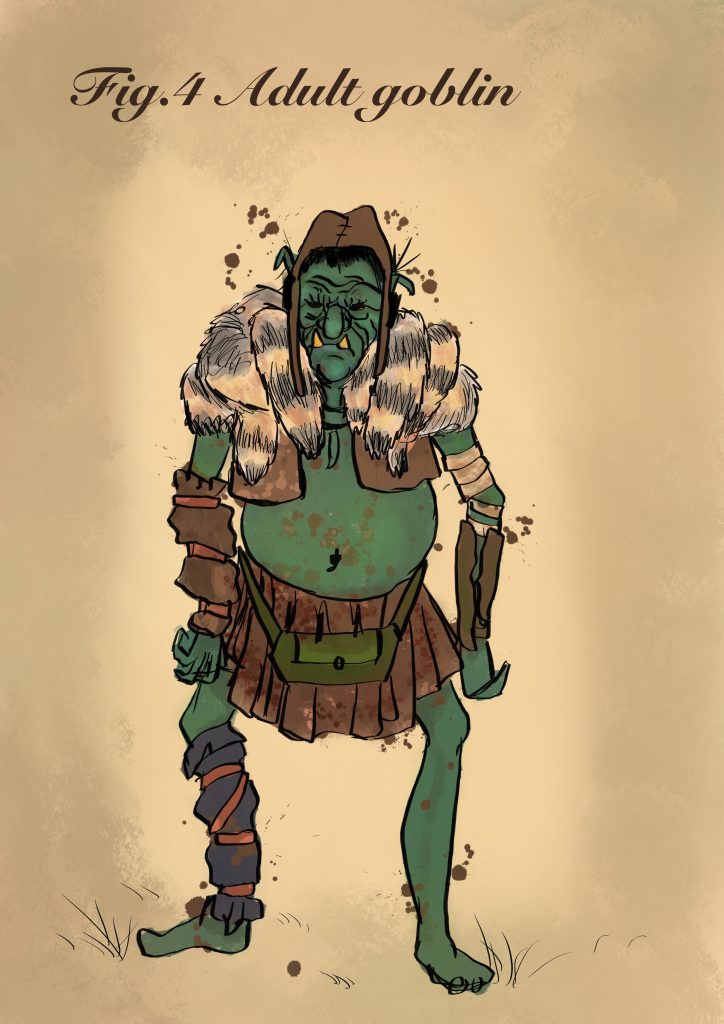
Goblins are humanoid, but always seen as grotesquely ugly and often small. As they have no particular skills, they do not keep themselves neat and socially acceptable; their only acquaintance being others of their kidney. Hence they are renown for being unkempt, unwashed, smelly and generally hideous of teeth and claws.
Behaviour
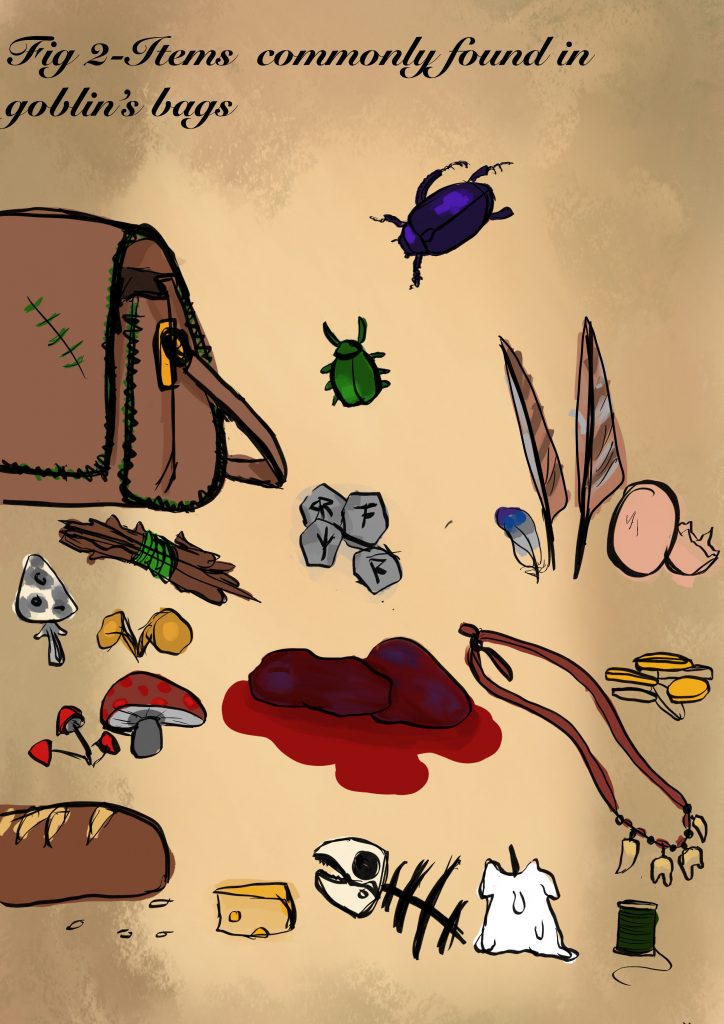
Goblins are known, not only to be mischievous, as can be the elves, sometimes, but, also, the goblins are, besides being greedy, downright malicious and vengeful. They are specifically greedy for silver and gold jewellery. Goblins also have magical abilities, but are not as adept as the elves. They live underground, but not in magnificent halls, as the dwarves. Rather, the goblins live in half burrows, or damp caves.
Origins
The word Goblin is said to be medieval, and to come from the Middle English, “gobelin”; which comes from the earlier Norse word, kobold. Other words for goblins are brownies, gnomes and imps. Hobgoblins are specific trickster goblins from the realms of Middle Earth that are now England and Scotland.
Point Of Interest
Tolkien based his own goblins in The Hobbit, on George MacDonald’s “The Princess and the Goblin”.
A Witness Account
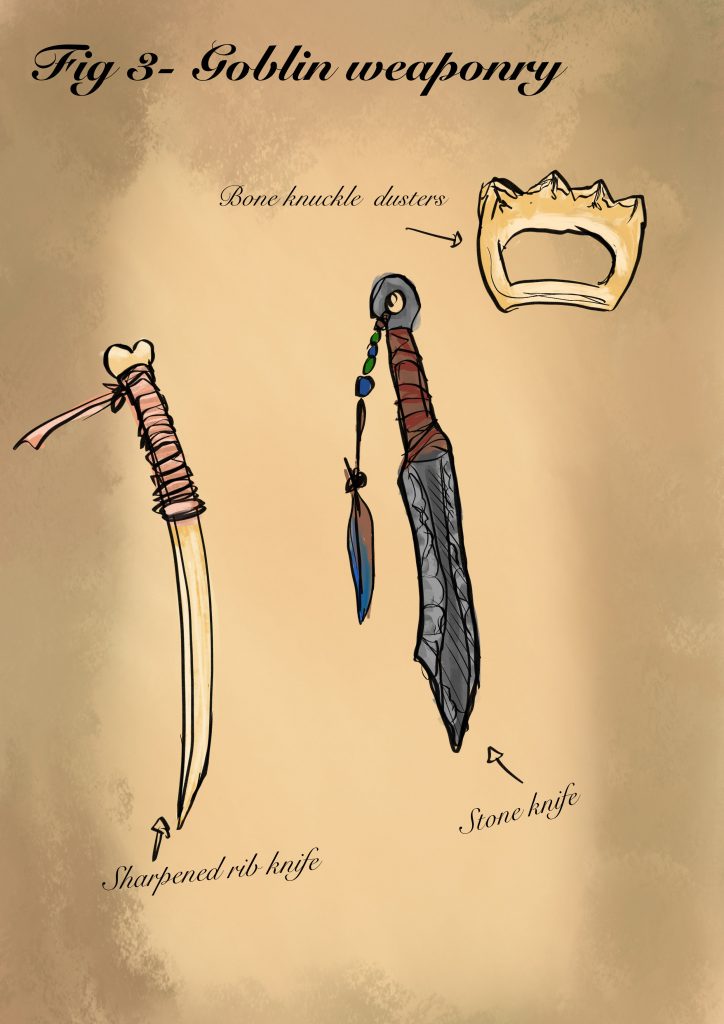
An account has recently come to light in the records of a small village, in Northumberland. The problems started when the mayor’s secretary’s documents all came out in green ink, no matter how carefully he mixed his inks. After a week of this, the mayor found that his mayoral robes had become two sizes too small for him and he was forced to wear his old robes. Worse happened when the village’s certificates of marriages and births started to go missing. At this point the village realised that they had a visiting goblin and that they had better appease him with offerings. They mayor refused to be influenced by what he said was nonsense.”, “The problems became an issue when the goblin spread his attentions to the rest of the village. Fires went out, mid cooking. Crops grew blight and the village council was embarrassed when they came to a council meeting, one day, to find that there was a cow standing on their meeting table. Still the mayor refused to make an offering to the goblin.
One morning, the mayor left for work and, kissing his wife, he found that her her smooth, golden hair, had become fizzy, brown and stuck up in ugly elf locks. “My dear, you really mustn’t let yourself go like this. I have my reputation as a mayor to uphold”. He left for work, while he wife fled sobbing to her room to dress her strange hair.
The following morning, when the mayor came to kiss his wife, as he was leaving for work, he reeled away from her when she looked up at him with the most terrible squint. “My dear, you really must get some spectacles, as your skenning is most unpleasant.”
On the Sunday, when the mayor came down in his best suit, for church, his wife came to join him, and she was in tears. Under her hat, her face was now covered in the most dreadful collection of buboes and lumps. This was in addition to her squint and terrible hair. The mayor reeled back, in horror. He ran up to his iron money chest and took out twenty pieces of gold. The mayor hurried back to his mayor’s room, in the village hall and left the pieces of gold on his desk, in a pile.
The following morning, his wife was returned to her usual self, the mayor’s robes fitted him and the pieces of gold were gone from his desk.
This goes to show that goblins do not give up, in their malice, and that they should be taken seriously.
The Dwarf
Did Female Dwarves Have Beards, too?
Etymology
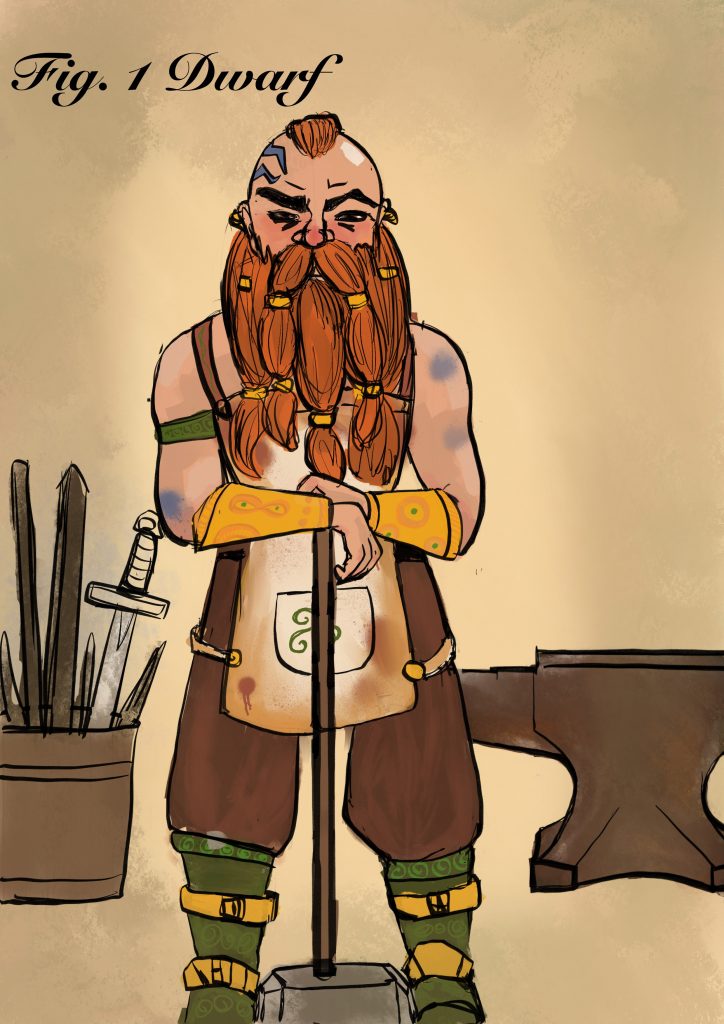
Old English dweorh, dweorg (West Saxon),” very short human being, person much below the ordinary stature, whether of proportionate parts or not,” also “supernatural being of subhuman size,” The word Dwarf comes from old German and refers to the supernatural beings, rather than the humans who have a growth challenge
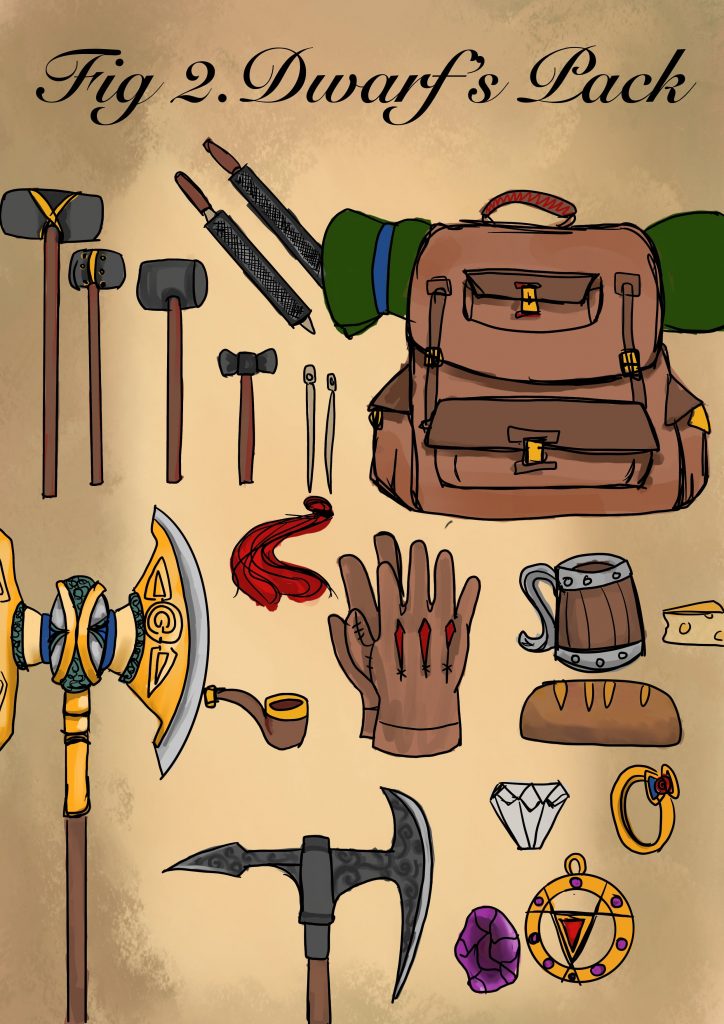
Dwarfs are mainly a Nordic and Germanic creature, with the Celts not really using that word to refer to them. Due to this, there are not so many different versions of dwarfs. And their myths and legends seem to contain mainly similar themes. They are quite consistent in their descriptions, all dwarfs live underground and are associated with metalwork. They are also considered to be deformed in height and covered with hair. They interact less with the humans then the elves do, instead, often interacting with the Nordic gods and goddesses in their aspects as metalworkers and guardians of mountains.
Physical Description
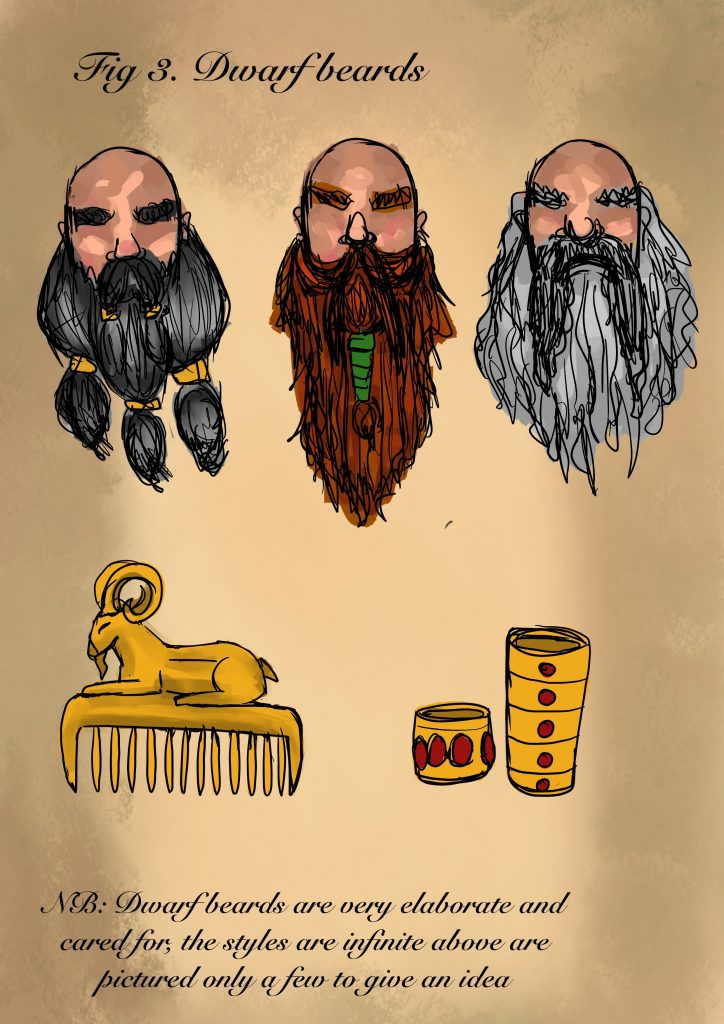
The dwarves of Middle Earth were humanoid, usually short and often hairy a. As ‘dwarf’ was probably another name for the Norse ‘black elves’, they were dark coloured. Although dwarves were short, they were said to have superhuman strength. The Norse credited them with having the attributes of a knight, i.e. they were warriors. Dwarves were usually bearded.
Behaviour
Dwarves typically lived in hollowed-out mountains and their occupations were mining and smithing. They were reluctant donors of artifacts with magical qualities. Dwarves were long-lived, stubborn and loyal, but grudge-bearing. They were very hard working and disciplined.
Origins
The modern English word “dwarf” comes from the Old English “dweorg” which came from the Norse “devergr”. It is generally thought that dwarves were actually another name for the Norse black elves, as both species were described in the medieval Norse text, Prose Edda, as living in Svartalfaheimr.
Point of Interest
It is presumed that Middle Earth had female dwarves, but these were hardly ever mentioned. From this we presume that they looked very similar and couldn’t be told apart by other species.
A Witness Account
Our story collector was staying near a castle which stood in ruin. When he asked about the cause of the family’s downfall, he was told the following account.
The wealthy man who dwelt there, in his sumptuous halls, Edred, became greedy for fame and renown in battle. He thus had his retainers kidnap and hold as prisoners two dwarves, Dvalin and Durin. Edred demanded that Dvalin and Durin make him a magic sword that would vanquish all of Edred’s enemies, so that Edred would become the greatest man in the land.
For a long time, Dvalin and Durin held out against the demand of Edred. Finally, after Edred had put them into separate cells, in his dungeons, and only fed them moldy bread for weeks, the dwarves agreed to meet his demand. Dvalin and Durin, however, conspired amongst themselves and agreed to put a curse on the sword.
On the day that the dwarves gave the sword to Edred, he let them go and went up to his battlements, to try and swing the sword in practice. While swinging the sword in terrible arcs, a servant came up to him with a message. Edred stepped forward to take the message, tripped over a stool and fell forward, stabbing his favourite hound, through the body.
Edred came down the stairs to tell his wife about his dog. Edred’s little son jumped out from his door as his father passed and shouted “Boo”, for fun. Edred whirled around, in surprise, and his sword sliced his son’s head clean off. There was a terrible cry and turning, Edred saw his wife standing there, staring in horror. His wife, Gudrun, stooped to pick up the sword, and then ran herself through with it, before Edred could stop her.
Edred screamed in horror, picked up the sword and ran outside past the gate to throw the sword down the cliff of the castle. The sword tripped him up as he attempted to throw it off the cliff and he went over with the dwarves’ tool.
As we can see gifts extorted from the dwarves brought terrible consequences. They were a very proud race and their skills in artificing were their own to give, or not. Kings and gods commissioned their work, but the dwarves’ work could not be forced.
The Elf
So What Exactly ARE Elves?

The origin of the word, Elf, in Norse, is Fair (or pale) Folk. Both the Norse and the Celts of Briton believed them human-shaped. Although the Celts originally thought them small, later ages re-envisaged them as normal, human sized. All of Middle Earth agreed that elves were beautiful. This beauty enabled the elves to seduce whom they would. They were often blamed for the unexplained disappearance of people. Elves, called Tylwyth Teg, by the Welsh Celts, were considered to be aristocratic with an appropriate mein of honour, hauteur, warrior skills, and magical abilities, etc.
The Norse had three sorts of elves. The light elves lived in the world of Alfheim, ruled by the Vanir god, Freyr. The ‘Dark Elves”, or dokkalfar, lived in Nidavellir. The ‘Black Elves’, Swartalfar, lived in Swartalfheim. All of Middle Earth considered elves, spirits, or minor deities of woodland, or the household.
Behaviour
Elves were universally acknowledged as having great powers, both physically, mentally and magically. Elves were known to be fierce guardians of their own abodes, e.g. a lake, a wood, a tree (usually hawthorn) or a stone circle. Punishment for a human’s purposeful, or even inadvertent incursion, was often the kidnapping of the human’s children, or their replacement with “changelings”. A changeling was similar to the human child, but the this changeling child’s behaviour was considered somewhat “fey”, strange, or otherworldly.

Elves often caused human illnesses. They did, however, have the power to heal, as well. Elves could interbreed with humans and the resultant progeny would have great intuition and magical powers. Humans could become elves after death.
Point Of Interest
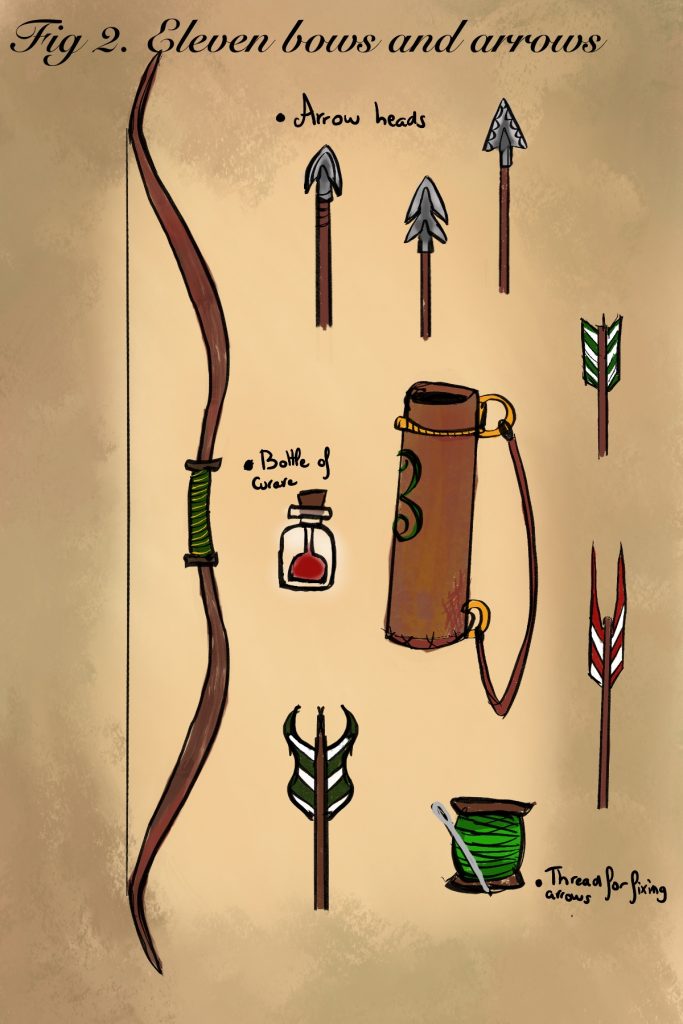
The fair folk were supposed to be repelled by iron and would avoid a human wearing a steel knife, or sword. Whenever you entered an eleven dwelling, you had to stick a knife, needle, or fish hook in the door, so that the elves would not be able to shut the door until you, the human, came out again. This was a safety ploy against kidnapping by the fair folk.
A Witness Account
Elves are known to move house at the end of the year, at the winter solstice. If a human sits at the crossroads at that time, the elves cannot get past. They will then try to trick the human appearing in the guise of the human’s relatives and asking him to go somewhere with them. If they fail in this seduction, they will be forced to offer gold, silver, and costly clothes.
It has been heard that a man called Dergen went and sat at the crossroads in a place called Neimi, one winter solstice. He saw the fair folk come up to the crossroads and he would not move. As they failed in their attempts at seduction, they started to pile up costly ornaments, jewels and delicate foods, but Fusi knew that he hadn’t to take these things until daylight, or they would all just disappear.
Just before their sun rose above the horizon, but when there was already a slight blush there, an elf maid came to Dergen with a ladle of meat and hot dripping. Dergen was very hungry with sitting there all night and he ate the meat and dripping. Suddenly all the pile of wealth disappeared and the sun rose.
Thereafter, Dergen was a little disarrayed in his mind, but he could, however, see people’s futures for them.
 The Greenlands Blog